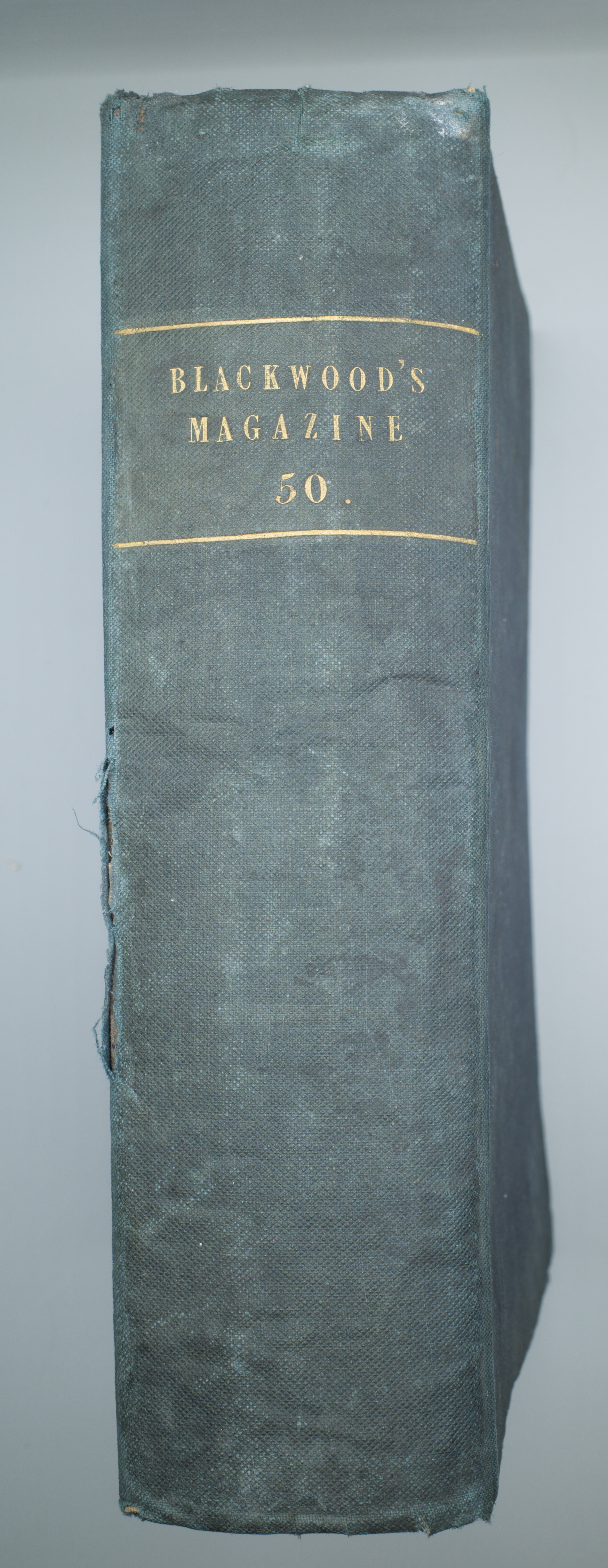
I bought an original 1841 volume of Blackwood’s Edinburgh Magazine. Why? Blackwood’s was part of the Brontë children’s reading world,1 and Emily’s diary paper for 30 July 1841 puts Blackwood’s Magazine in the Parsonage at Haworth, where Aunt Branwell was reading it to Patrick Brontë.2 My copy is volume L, the July–December 1841 volume.
- Emily Brontë lived in 1841.
- Blackwood’s was being read in the Parsonage on 30 July 1841.
- My volume contains the six monthly numbers for July–December 1841.
All three statements are true, but sadly, they do not add up to provenance. There is no evidence connecting my copy to Emily or the Brontë household. And in its complete July–December form, the volume I own could not yet have existed on 30 July: five of its six monthly numbers had not been published.3
What the connection actually is to Emily Brontë
Emily’s diary paper for 30 July 1841 says she had “a good many books on hand.” It also puts Blackwood’s Magazine in the Parsonage that evening. Aunt Branwell was reading it to Patrick Brontë.2
Why buy a Blackwood’s Magazine?
I wanted it. The research answer: a PDF wouldn’t allow me to answer many of the following questions:
- Q: What did a volume of Blackwood’s feel like?
- A: An old book. Probably not old to someone in 1841, but it’s what it feels like today. Mine isn’t in particularly great condition, especially the binding, but the pages look and feel like a book from the 1800s.
- Q: What’s inside an 1841 volume of Blackwood’s Edinburgh Magazine?
- A: Quite a lot: British politics and elections, foreign affairs, economics, historical essays, philosophy, literary criticism, serialized fiction, songs and poems, satire. On paper, this magazine has it all.
- Q: How close is this Blackwood’s volume to a modern magazine?
- A: As my copy survives, it is much closer to a regular book than to what I would call a modern magazine. The bound volume has no illustrations or advertisements, the paper is thicker than in most books printed today, and the writing is dense. Blackwood’s was originally issued by month.3 My next purchase will look to grab a single month issue.
This is but the start of formalizing a study on What Did Emily Brontë Read? Just because a critical essay on Plato’s The Republic appears in this 1841 volume doesn’t necessarily mean that Emily Brontë read the article, or Plato for that matter. Nevertheless, it’s as good a starting place as any to begin piecing the puzzle together.
Contents of the July–December 1841 volume
Contents of volume 50 of Blackwood’s Edinburgh Magazine, July–December 1841. Open a month to see its titles and opening page numbers.
July 1841
August 1841
September 1841
October 1841
November 1841
December 1841
Titles follow the six monthly contents sheets, with capitalization and punctuation lightly regularized and author credits omitted. Grouped pieces remain grouped. The starred July page number is retained as printed. The September contents sheet gives page 325 for The World of London, Part V; the article begins on page 327.
Source: Blackwood’s Edinburgh Magazine, vol. L (July–December 1841), monthly contents sheets in the University of Toronto copy, digitized by the Internet Archive. Checked 18 September 2026.
References
Footnotes
-
Christine Alexander, “Readers and Writers: ‘Blackwood’s’ and the Brontës,” The Gaskell Society Journal 8 (1994), pp. 54–69, JSTOR record, checked 21 September 2026. Scholarly study of the Brontës as readers and writers of Blackwood’s. ↩
-
The Open University, UK Reading Experience Database, record 4323, “Emily Bronte, diary paper for 30 July 1841,” citing Juliet Barker, ed., The Brontës: A Life in Letters (1997), p. 95, database record, checked 21 August 2026. ↩ ↩2
-
J. M. Milne, “The Politics of Blackwood’s, 1817–1846: A Study of Political, Economic and Social Articles in Blackwood’s Edinburgh Magazine and of Selected Contributors,” PhD dissertation, Newcastle University, 1984, Appendix II, “Key to volumes and numbers of Blackwood’s, 1817–1846,” online appendix, checked 21 September 2026. The appendix records the regular January–June and July–December six-number volume structure by this period. ↩ ↩2