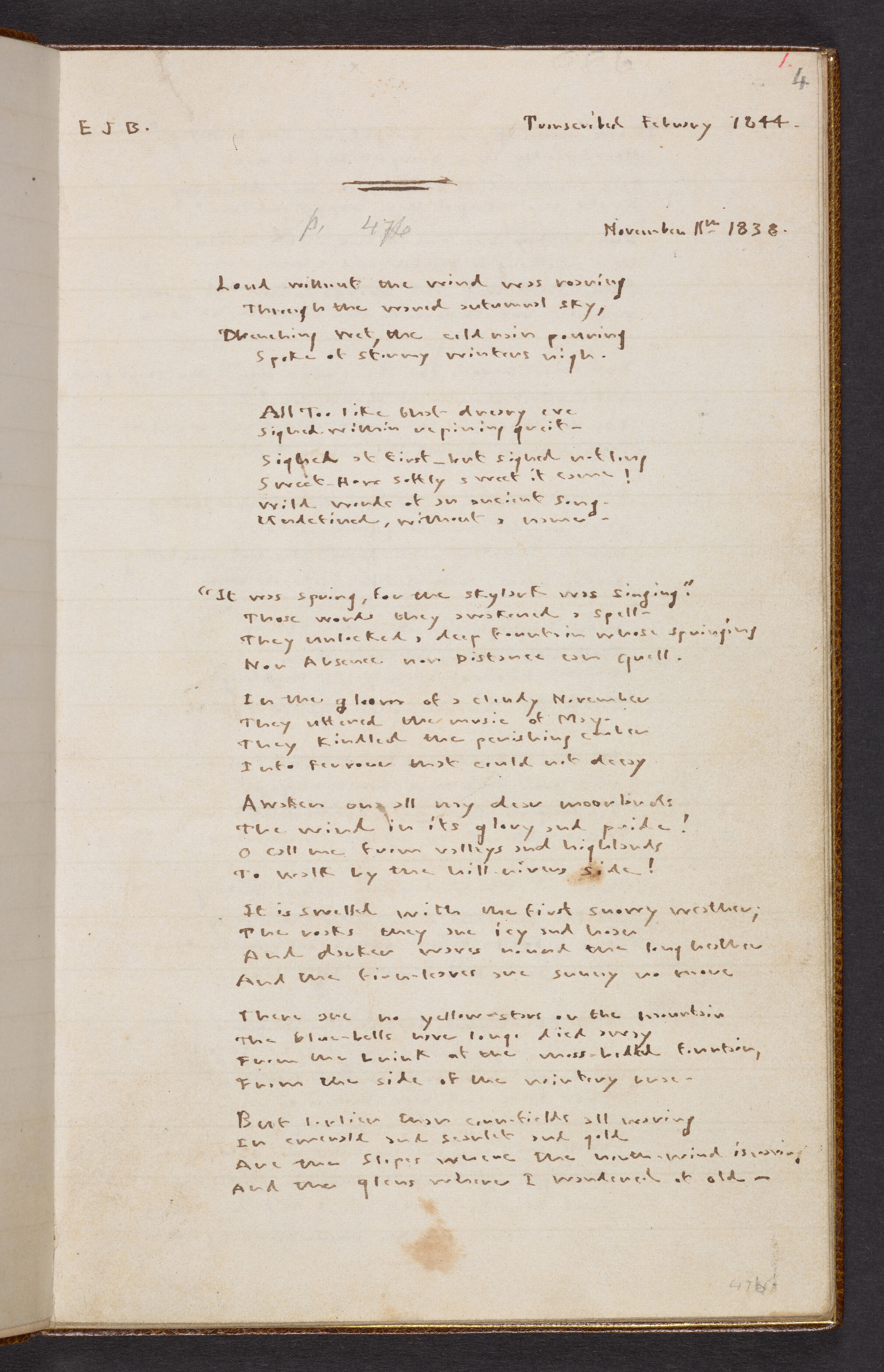
Before dying in 1848 at just 30 years old, Emily Brontë published only a single novel, Wuthering Heights, and a small body of poetry alongside her sisters.1,7
Popular impressions of Emily are often filtered through Wuthering Heights and her poems, while biographical claims rely on records and accounts left by her sisters and family friends.1,7 Her diary or birthday papers, Brussels devoirs, poems, and other manuscripts provide documentary evidence only when their dates, provenance, or contents bear on a specific claim.5,6,7,11
This biography sets out what is known, how it is known, and where claims become speculation or overreach. Its purpose is to bring forward what the evidence can actually support amid the treacherous game of telephone that plays out across the web today, with existing Brontë scholarship as its foundation.
Thornton and Haworth
Modern biographical and institutional consensus gives Emily Brontë’s birth date as 30 July 1818.1,7 She was born in Thornton, Yorkshire, to Maria Branwell Brontë and the Reverend Patrick Brontë. Because civil birth registration had not yet begun, this date does not come from a birth certificate. The Thornton parish register records Emily’s baptism on 20 August 1818.2,3,4
The family moved to Haworth in 1820. Just one year later, Maria Brontë died, after which her sister, Elizabeth Branwell, became a permanent part of the Brontë household.1
Childhood writing and Gondal
In 1824, Emily, then six years old, entered Cowan Bridge School, established for daughters of clergymen. In 1825, her sisters Maria and Elizabeth died from tuberculosis, and Patrick removed both Emily and Charlotte from the school.1,7
Emily and Anne developed an imaginary world called Gondal, populated by kingdoms, rulers, political factions, wars, and romances.1,6,8,12 They used it as the setting for prose narratives and poems, although most of its prose no longer exists.6,12
The earliest direct reference appears in Emily and Anne’s diary paper of 24 November 1834, which states that “The Gondals are discovering the interior of Gaaldine.”11,12 Emily was sixteen and Anne fourteen.1,11,12 In her diary paper of 26 June 1837, Emily recorded that she was writing the first volume of Almeda’s life and was four pages from its end.11,12
Education, work, and Brussels
Emily attended Roe Head, a girls’ boarding school in Mirfield, West Yorkshire, in 1835, although she left after about three months.1,7
Emily later taught at Law Hill School in Southowram, West Yorkshire. Most modern chronologies place her there from September 1838 until April 1839, although published sources differ over the precise dates.1,7
In February 1842, Emily travelled to Brussels with her sister Charlotte to study at the Pensionnat Heger. They remained there for about nine months before returning to Haworth following the death of Elizabeth Branwell. Emily did not return to Brussels, while Charlotte resumed her place at the school in January 1843.1,7
Publication as Ellis Bell
Charlotte later wrote that, having found a manuscript volume of Emily’s poetry, she urged Emily and Anne to join her in publishing a volume of poems.1 Poems by Currer, Ellis and Acton Bell appeared in May 1846 under the pseudonyms Currer (Charlotte), Ellis (Emily), and Acton (Anne) Bell. The following year, in December 1847, Emily saw her first and only novel, Wuthering Heights, published under the pseudonym Ellis Bell.1,7
Death and burial
Emily’s death registration records her cause of death as “Consumption — 2 months — certified.” The recorded duration places the beginning of her final illness around October 1848.9 “Consumption” was a historical term used for tuberculosis.15
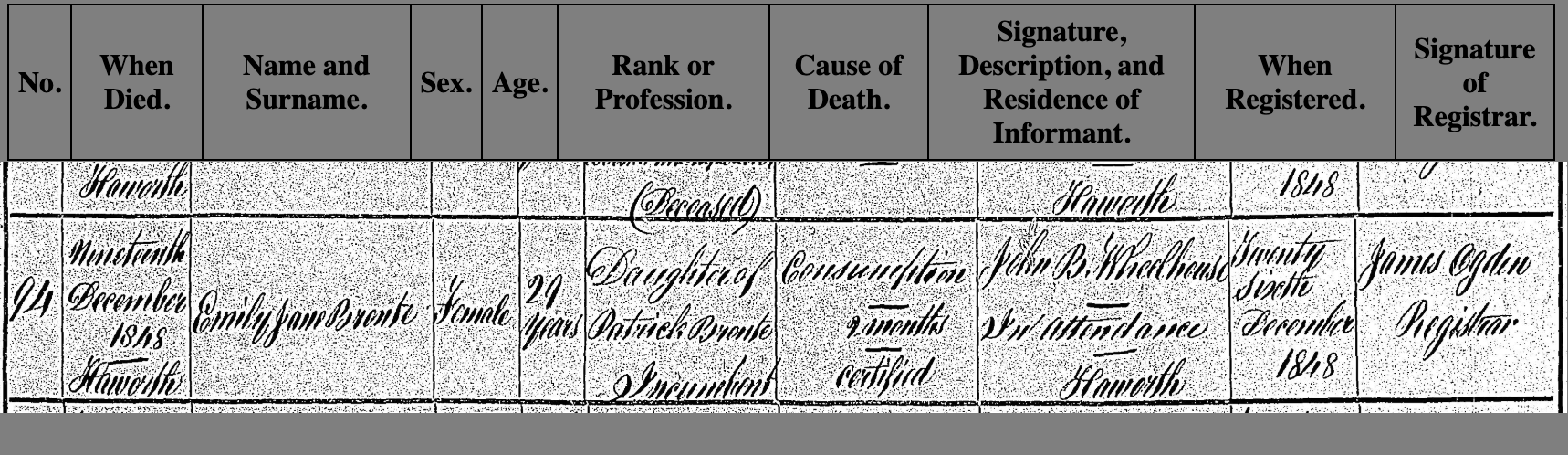

As seen in the official death registration documentation above, Emily was recorded as being twenty-nine years of age.9 Her baptism on 20 August 1818, however, indicates that she would have been at least thirty when she died.2,3,4 Modern biographical and institutional consensus gives her birth date as 30 July 1818, which likewise places her age at thirty.1,7
Institutional accounts date Emily’s burial to 22 December 1848 and identify the Brontë family vault beneath St Michael and All Angels’ Church in Haworth as her burial place.1,13 The Haworth parish burial registers are held by the West Yorkshire Archive Service under collection BDP48, but this project has not yet examined the relevant entry and has not located a separate vault record.14
What’s to Come
Emily left no autobiography and little correspondence.5,6,7 This biography separates documentary fact from testimony and interpretation and will expand as further records are verified. Her writing and surroundings are not treated as direct biographical evidence without a stated argument.
Sources
- Brontë Parsonage Museum, “The lives of the Brontës”, checked 9 September 2026. Back to citation
- West Yorkshire Archive Service, Thornton St James parish records, collection BDP92, baptism registers 1678 to 1971, collection reference checked 24 October 2026. Back to citation
- Europeana, “Celebrating Emily Brontë”, description of Emily Jane Brontë’s baptism-register entry, checked 24 October 2026. Back to citation
- William Scruton, Thornton and the Brontës (1898), page 19, published transcription of the Thornton baptism register, checked 24 October 2026. Back to citation
- British Library Archives and Manuscripts Catalogue, Emily Brontë’s notebook of poems, Add MS 89488, checked 9 September 2026. Back to citation
- British Library Archives and Manuscripts Catalogue, Emily Brontë, The Gondal Poems, Add MS 43483, checked 9 September 2026. Back to citation
- University of Leeds Special Collections, “Emily Brontë (1818–1848), Author, Poet”, checked 9 September 2026. Back to citation
- University of Leeds Special Collections, “Branwell Brontë Angrian manuscripts”, including the record of the siblings’ imaginary kingdoms, checked 9 September 2026. Back to citation
- General Register Office for England and Wales, death registration of Emily Jane Brontë, 1848, December quarter, Keighley Union, volume 23, page 237, Online View digital image obtained and examined 24 October 2026. See The National Archives, “Reproduction of birth, death and marriage certificates”, for the official Crown copyright reproduction guidance for online and book publication. Back to citation
- HM Passport Office and General Register Office, “How to order and pay for civil registration records”, checked 24 October 2026. Back to citation
- National Manuscripts Conservation Trust, “Conservation of the manuscripts of Emily Brontë”, identifying the 1834 diary paper as part of the Bonnell collection and the illustrated diary paper of 26 June 1837 as Brontë Society reference BS 105; also see the existing public-domain reproduction of the 1837 paper. Checked 26 October 2026. Back to citation
- British Literature OER, “Emily Brontë (1818–1848)”, supplying the published transcription of the 1834 Gaaldine passage and describing the contents of the 1837 diary paper. Checked 26 October 2026. Back to citation
- Haworth Parish Church, “Brontë Connection”, stating that the family other than Anne was interred in the tomb beneath the church. Checked 26 October 2026. Back to citation
- West Yorkshire Archive Service, Parish Registers collection guide, identifying Haworth St Michael parish records as collection BDP48 and confirming that its burial registers cover 1848. Checked 26 October 2026. Back to citation
- NCBI Bookshelf, “Epidemiology—Tuberculosis in Adults and Children”, explaining that consumption was among the historical names used for tuberculosis. Checked 26 October 2026. Back to citation