Current scope: The catalogue contains two lifetime painted likenesses, one lifetime self-representation, three later reproductions of earlier paintings, and one first-person description published by Ellen Nussey. A separate problem register records one documented sitter misidentification, two claimed photographs, two disputed paintings, and two problematic likeness accounts without admitting any of them as likeness evidence. No photograph from life has entered the catalogue.
Several Emilys occupy the same search result
Constructing a likeness of Emily Brontë is a nuanced, oftentimes unreliable pursuit. The surviving evidence can bring us closer to her appearance, but it cannot produce a definitive likeness. Sources include a damaged family painting, the fragment of another family portrait, a twentieth-century print after that fragment, a colourised crop, or an imagined portrait made after her death. Written accounts introduce another set of faces filtered through memory, biography, and language.
This catalogue serves as a register for these artifacts and descriptions. It establishes what each source can show, how it reached us, and where its authority ends.
Current visual register
Swipe to see all columns
| Object | Date and maker | Description |
|---|---|---|
| Pillar Portrait NPG 1725 | Branwell Brontë, circa 1834 | Lifetime group portrait; Emily identified at centre |
| Profile Fragment NPG 1724 | Branwell Brontë, circa 1833 | Lifetime portrait; currently Emily, historically disputed as Anne |
| Medici Collotype NPG D32170 | 1914, after NPG 1724 | Derivative; no independent appearance evidence |
| Diary Sketch 26 June 1837 | Emily Brontë, 26 June 1837 | Lifetime self-representation; sketch |
| Pillar Photograph Reproduced in Chadwick, 1914 | Photographer unknown; reproduced by Mrs Ellis H. Chadwick | Derivative documentary image; records an earlier state of the painting |
| Gun Group Engraving Published in Turner, 1879 | Published by J. Horsfall Turner, 1879 | Derivative; important to a later Emily-versus-Anne identification error |
The Pillar Portrait
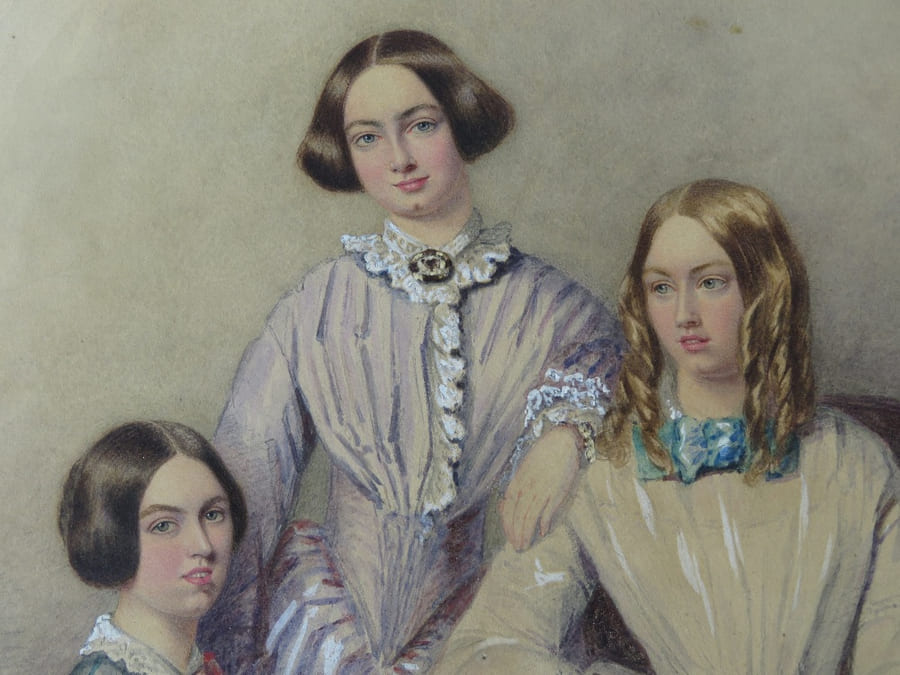
Branwell Brontë painted his sisters Anne, Emily, and Charlotte in oil around 1834. The National Portrait Gallery identifies Emily as the central sister.
The Gallery records that the folded canvas was rediscovered in 1914 on top of a wardrobe in Ireland. Folding, storage, damage, and conservation form part of the evidence because the surface now available to viewers is also the history of what happened to the painting.1
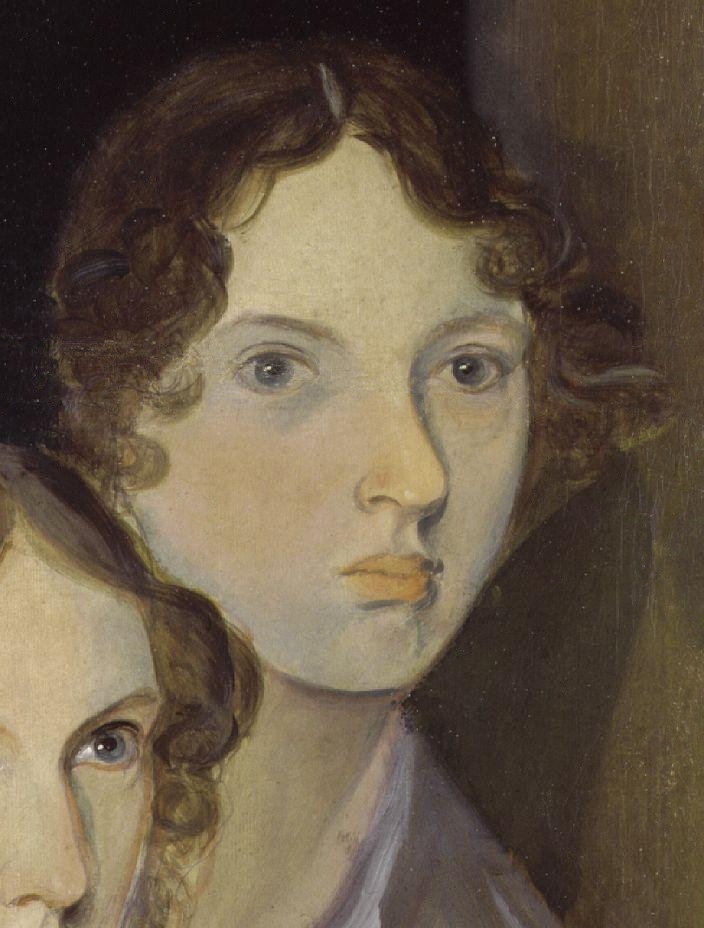
This crop of the Pillar Portrait appears to offer dark blue-ish eyes, brown curly hair, possibly dark circles under the right eye (facing out), and pronounced philtrum.
One further compositional detail sits behind the portrait's familiar name. The painting originally included a male figure, almost certainly Branwell's self-portrait, which was later painted over with the pillar.1
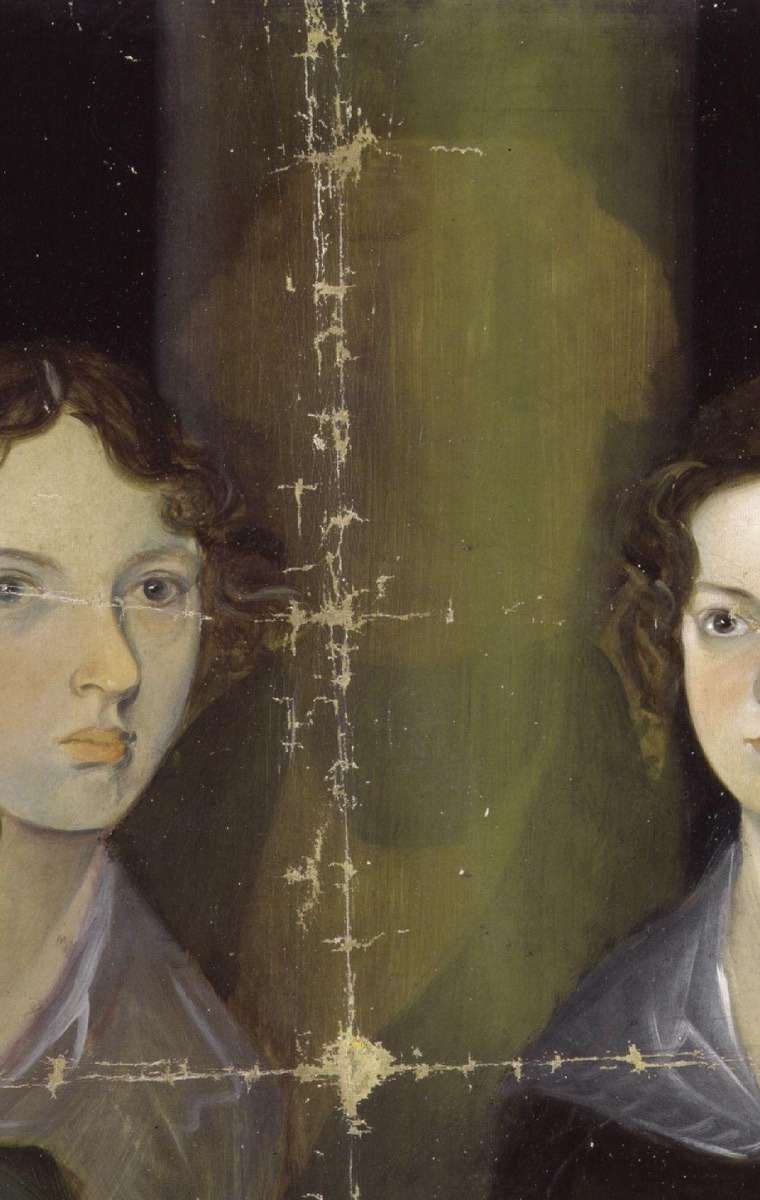
This detail documents a known alteration to the painting's composition. The Gallery explains that the covering paint thinned over time, allowing the underlying figure to become visible. That makes the object visibly layered and damaged; it does not, by itself, show that Anne, Emily, or Charlotte's faces were similarly repainted, or prove that they were untouched.1
The Profile Fragment
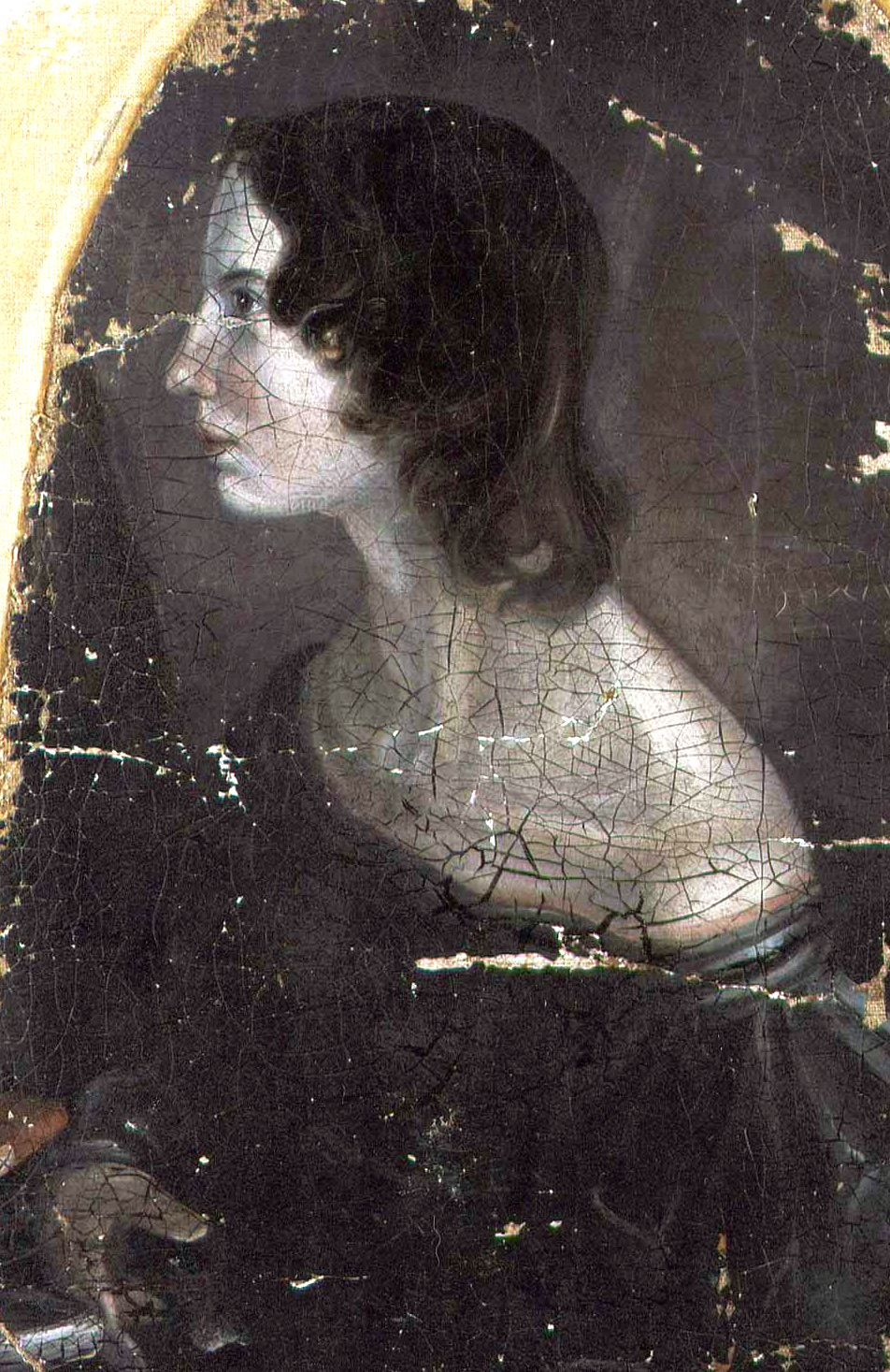
The surviving profile is a fragment of a larger group portrait that once showed the siblings with a gun. The National Portrait Gallery currently catalogues the sitter as Emily. However, whether or not the sitter is Anne Brontë instead remains in dispute.2
The fragment survived because Arthur Bell Nicholls cut it from the larger painting. As his second wife later recalled to the Gallery, he had “cut it out of a painting done by Branwell as he thought it good but the others were bad.”2
The Medici Collotype
The National Portrait Gallery holds a colour collotype issued by the Medici Society in 1914 after the profile portrait.3 This reproduction provides an early example of the form in which Emily’s newly recovered likeness entered public circulation. Set beside the digital reproduction of the Profile Fragment, it shows how two reproductions of the same painting can produce different impressions. It offers no second view of Emily: every feature in both panels descends from NPG 1724.
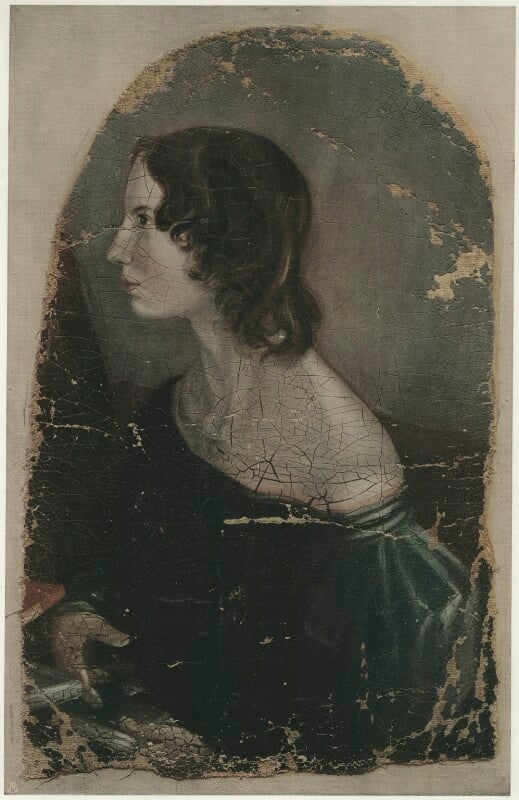
The digital reproduction at left is cooler, brighter, more tightly framed, and more contrast-heavy. Cracks, losses, and the pale face and neck stand out. The 1914 collotype at right is warmer and flatter, includes a pale printed border, and softens or compresses some surface damage and tonal transitions. Hair, skin, dress, and background consequently read differently even though the underlying portrait is the same.
Time also mediates the comparison. The collotype was issued in 1914, the year the National Portrait Gallery acquired the fragment, but the Gallery record does not date the photographic image from which the collotype was made. The surviving source chain for the digital file at left does not provide a secure capture date either. The comparison therefore cannot determine exactly what changed in the painting itself, or separate condition and conservation from lighting, photographic exposure, colour reproduction, printing, paper, and later scanning.
Placed together, the two images show that photographs and printed reproductions alter our perception of a painting, and that the point in the painting's history at which an image was made matters. Neither reproduction is transparent access to the sitter or to a timeless, unchanging artwork.
Medici collotype source: National Portrait Gallery, NPG D32170. Reproduced under the Gallery's CC BY-NC-ND 3.0 licence.
Further crops, engravings, colourisations, and book-jacket portraits will be added only when they mark a meaningful stage in that transmission. A hundred copies of one source remain one source.
The Diary Sketch
Emily’s diary paper of 26 June 1837 includes a small drawing of herself and Anne at the dining-room table, surrounded by the sisters’ writing. Emily labels the two figures beneath the scene.4
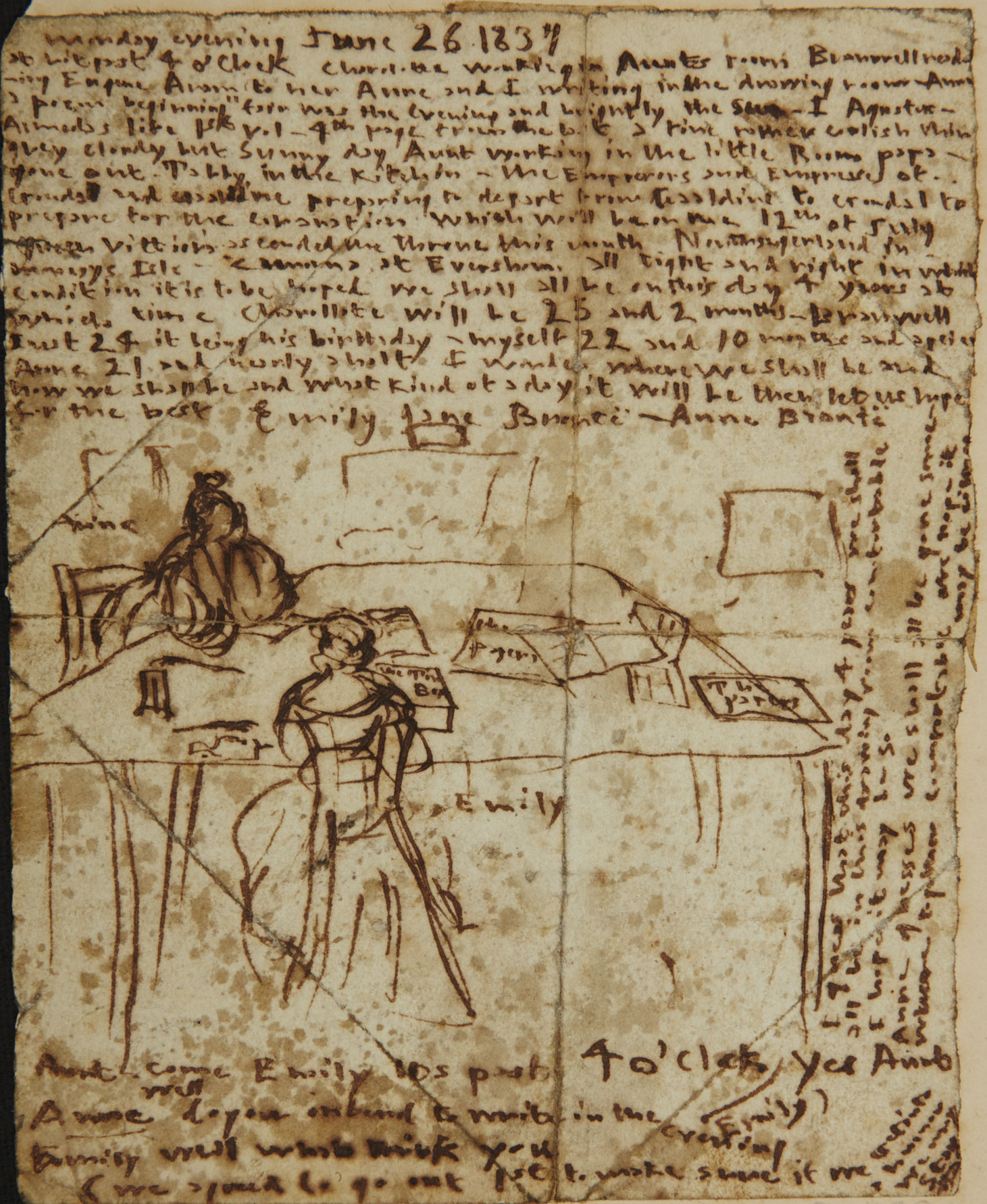
This is a lifetime image made by Emily herself, which makes it unusually close to its subject in one sense and very limited in another. The figures are tiny, schematic, and occupied with work. The drawing can enter a record of how Emily represented herself and her shared life with Anne. It cannot be mined for the shape or colour of her features.
The Pillar Photograph
An early photograph of the Pillar Portrait was made at Haworth before the painting was taken to Ireland. The National Portrait Gallery says that this photograph records the work in its original condition. Mrs Ellis H. Chadwick reproduced it opposite page 116 of In the Footsteps of the Brontës in 1914.5
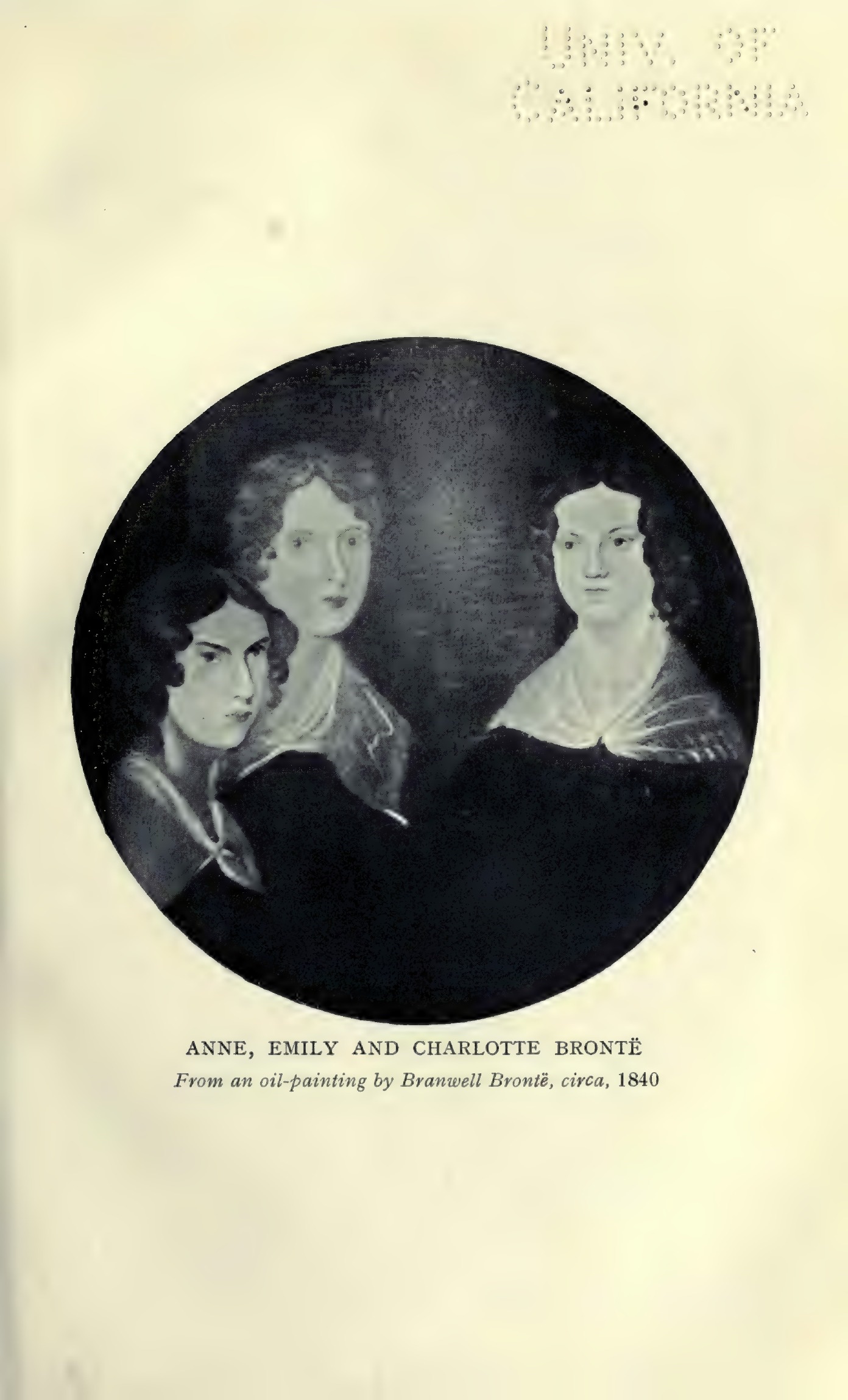
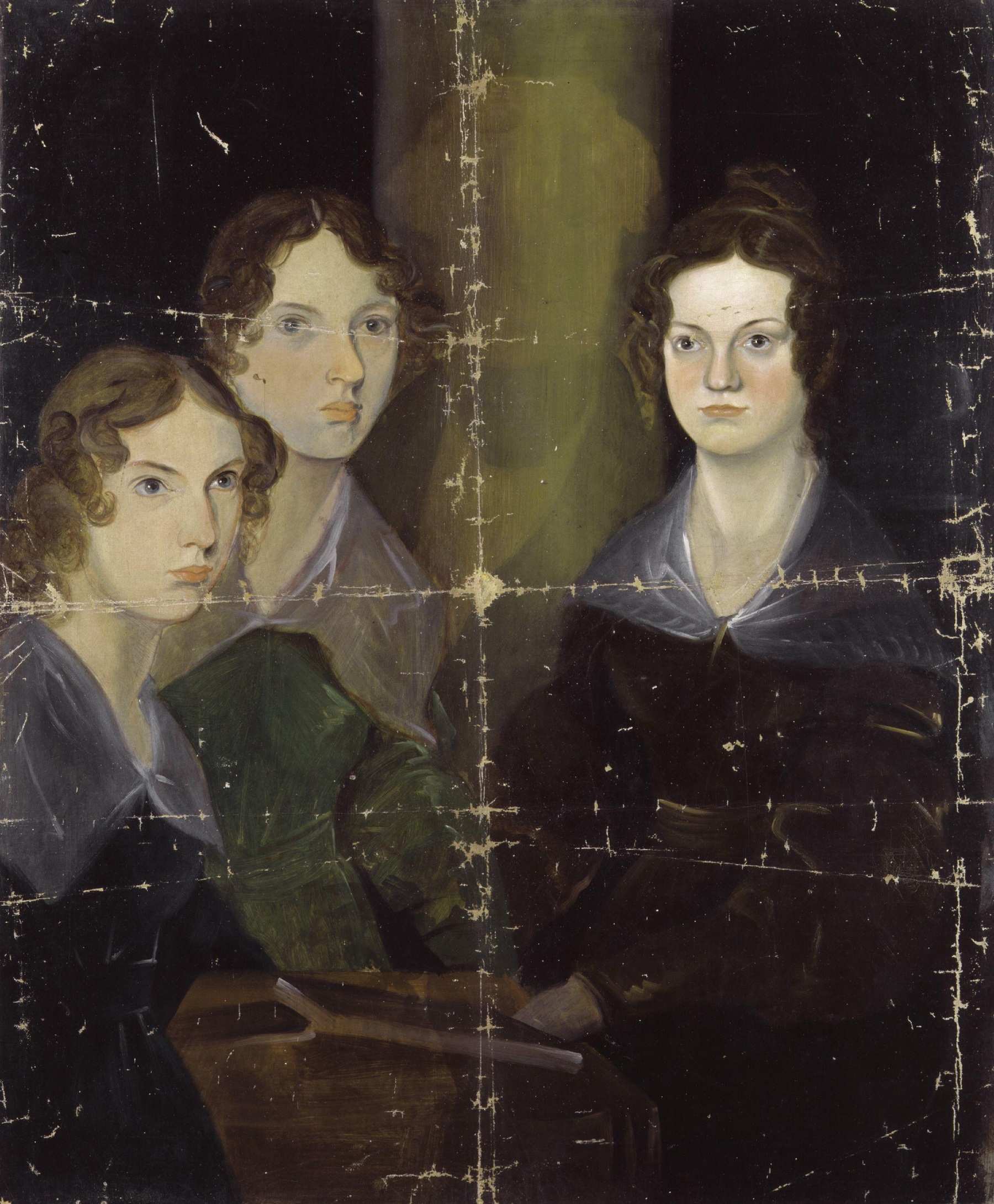
The National Portrait Gallery describes the source image as an early daguerreotype made at Haworth before the painting was removed to Ireland and says that it showed the work in its original condition. What survives here is not that daguerreotype, however, but its monochrome, circularly cropped reproduction in a 1914 printed book. The painting later spent years folded and was rediscovered with crease lines. After the Gallery acquired it in 1914, a “special lining” stabilised the canvas while allowing the damage to remain visible.56
The complete images are therefore placed together as documentary states. Chadwick’s plate omits most of the lower canvas and compresses colour and detail into a narrow range of grey tones. Its quality is too limited to determine exactly what changed in Emily’s face or elsewhere in the painting through folding, surface damage, conservation, photography, printing, or scanning. Apparent differences in facial shape or contrast cannot be treated as evidence about the sitter or as a reconstruction of the undamaged painting. The printed date, “circa 1840,” likewise preserves the book’s 1914 cataloguing rather than the Gallery’s present circa-1834 date.
The Gun Group Engraving
The original Gun Group painting is lost apart from NPG 1724. A photographic copy made before the painting’s destruction survives at the Brontë Parsonage Museum, but it is itself a copy of an earlier daguerreotype and is badly degraded. J. Horsfall Turner published the engraving below in Haworth: Past and Present in 1879. By that date the lost painting had already entered both photographic and engraved transmission. The exact source generation used by the engraver still needs to be confirmed.7
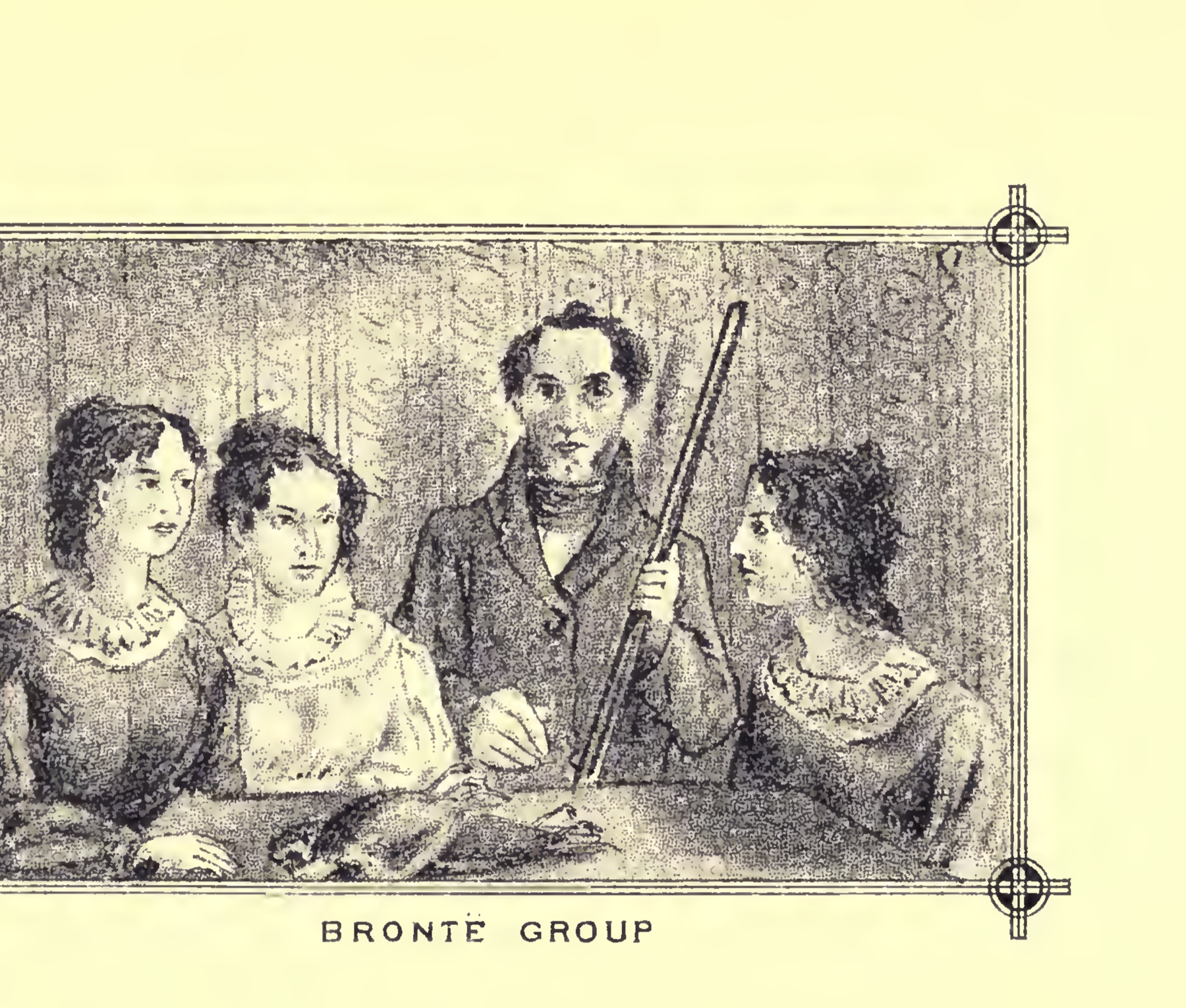
The identities attached to that chain did not remain stable. Ellen Nussey labelled a print with Emily at the left and Anne as the profile figure at the right. The right-hand figure was nevertheless later reproduced as Emily. The National Portrait Gallery’s extended catalogue says that frontispiece figure almost certainly represents Anne, while the surviving painted fragment from the same position remains catalogued as Emily and historically disputed.2
This is the clearest rejected likeness in the present record: not a rejected object, but a rejected identification applied to one of its derivatives. The engraving can document how the error travelled. Its simplified faces cannot decide which sister appears in the surviving fragment.
Claims outside the admitted catalogue
“Debunked” is too broad for every disputed face. One case below contains a specific sitter error; two photographic objects postdate Emily’s death and depend on undocumented copy theories; two paintings have advocates but no accepted attribution. None supplies appearance evidence at present.
Swipe to see all columns
| Claimed object | Problem | Description |
|---|---|---|
| Ellen Nussey Photograph Wikimedia Commons | The sitter is Ellen Nussey; the error demonstrates how an unsupported Brontë identification can persist through copying and republication | Sitter identification corrected |
| “Les Sœurs Brontë” Photograph The Brontë Sisters—A True Likeness? | The 1850s object postdates Emily and Anne; the claim requires it to be a copy of an unlocated 1840s daguerreotype, and no clear provenance connects it to the family | Not authenticated; not admitted |
| “Bells” Photograph London Review of Books, 2015 | Sold online in 2015; the process dates from after Emily and Anne’s deaths | Chronologically impossible as a direct sitting; copy claim unproved |
| Lost Bonnet Portrait The Bookman reproduction, 1896 | Christopher Heywood argued that it recovered the portrait William Robertson Nicoll saw in 1879; Sarah Fermi, Patsy Stoneman, and Edward Chitham published a joint response disputing that case | Contested attribution; not admitted |
| Landseer Watercolour Regis and Wynne, 2017 | Auction publicity exceeded the surviving institutional judgment; the National Portrait Gallery filed it among doubtful Brontë portraits and recorded the artist only as possible | Doubtful sitter and artist attributions; not admitted |
Those judgments should be testable against the objects themselves. The five problem images are therefore reproduced below at identification scale. Their placement makes the problem register visible; it does not admit any object to the catalogue or turn resemblance into evidence. The image routes are the public-domain Ellen Nussey file, the “Les Sœurs Brontë” claimant site, the Paris Review reproduction, the public-domain 1896 Bookman page reproducing the Bonnet image, and the Landseer-claim report.8
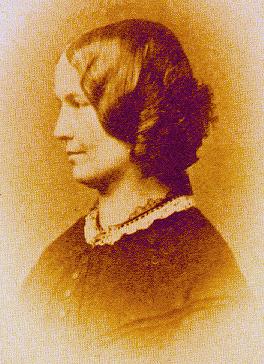
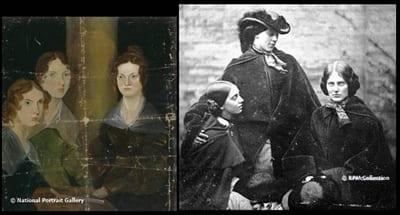
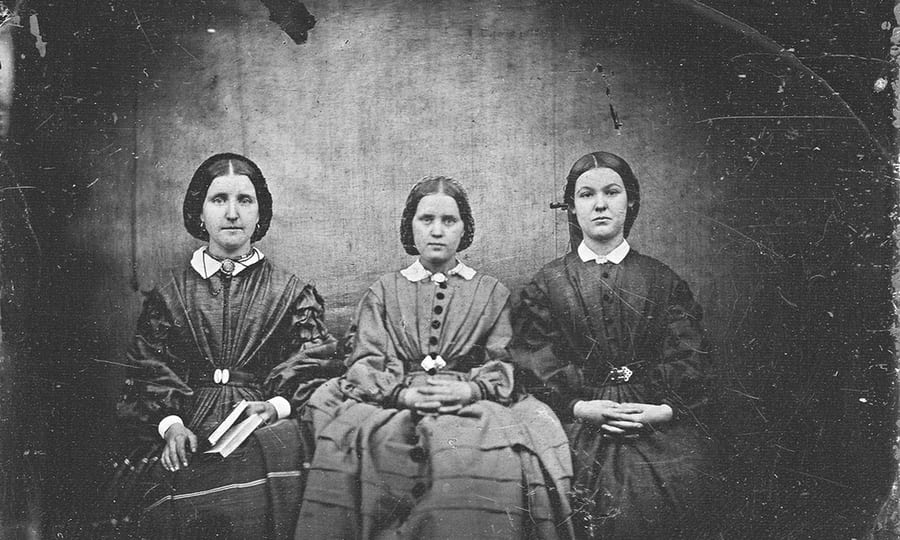
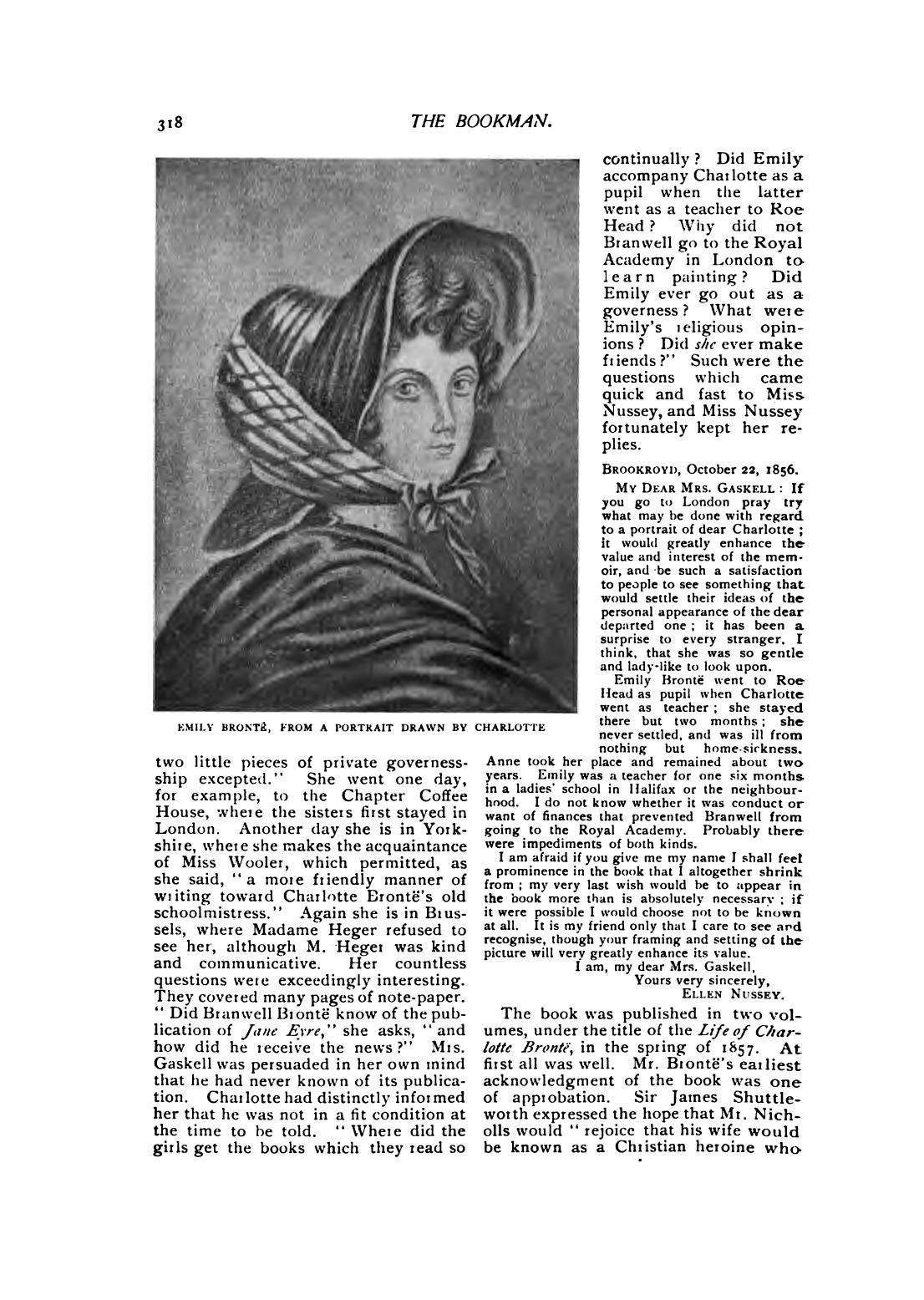
These reduced files are shown only so readers can identify and assess the claims under discussion. The captions retain the unresolved rights boundary instead of presenting the files as openly licensed, and the images should be removed or replaced if a rights holder supplies contrary terms.
The Bonnet Portrait deserves a genuinely open label. Heywood’s 2015 and 2018 articles connected the painting, a pencil copy, and a red Conté copy with Nicoll’s lost portrait and the image published in The Woman at Home in 1894. The published 2019 response by Fermi, Stoneman, and Chitham disputed that identification. An auction inscription and a resemblance between copies are evidence to test.9
The Landseer claim has a different weakness. A group watercolour bought in 2009 was promoted as a circa-1838 portrait of the sisters by Edwin Landseer. Auction accounts later described an NPG attribution, but a scholarly inquiry reported the Gallery’s actual record as “doubtful” for the sitters and only “possibly” Landseer for the artist. The work belongs in the history of Brontë claims.10
The Lost Portrait Account
William Robertson Nicoll saw a portrait of Emily in Martha Brown’s possession in 1879. His earlier published account called it a clearly and boldly drawn pencil sketch by Charlotte. In 1908 he called the lost object a fine and expressive painting. The later phrase has been used to connect his memory to NPG 1724; Heywood instead argued that the earlier description supported the Bonnet Portrait and its pencil copy.11
The contradiction must remain visible. “Sketch” and “painting” may have been used loosely, or Nicoll’s memory may have shifted, or two objects may have become entangled in later retelling. Until the physical and documentary chain is closed, his account cannot independently authenticate NPG 1724, the Bonnet Portrait, or any other candidate.
Nicholls Judges a Poor Reproduction
Clement Shorter sent Arthur Bell Nicholls a photograph of the Pillar Portrait in 1897. Nicholls reportedly replied that none of the figures resembled Emily or Charlotte, although the original painting remained in his possession. That judgment cannot overturn the object’s sitter history: its rejection of Charlotte as well as Emily shows how a witness response can be distorted by a poor reproductive state, an uncertain prompt, or memory itself.12
Current description register
Swipe to see all columns
| Witness and source | Relation to Emily | Description |
|---|---|---|
| Ellen Nussey Scribner’s Monthly, 1871 | Knew Emily; describing an 1833 visit decades later | First-person retrospective description |
| Laetitia Wheelwright Later biographical report | Fellow pupil in Brussels; wording currently traced through later biography | Reported witness; original response to Clement Shorter needed |
| Mary Taylor Reported by Gaskell, 1857 | Family friend; mediated through the 1857 biography | Reported witness; original wording needed |
| Martha Brown or Tabitha Ratcliffe First publications unresolved | Parsonage household testimony; exact first publications unresolved | Lead queue; no wording admitted yet |
Only Ellen Nussey’s description is admitted to the present register. The other entries remain provisional until their original documents or first publications are recovered.
Ellen Nussey Remembers Emily at Fifteen
Ellen Nussey visited Haworth in 1833 and later published “Reminiscences of Charlotte Brontë” in the May 1871 issue of Scribner’s Monthly. Her description calls Emily’s figure “lithesome” and “graceful” and says she was the tallest person in the house apart from Patrick Brontë. Nussey remembers little colour in her complexion, hair worn in a tight curl and frizz, and eyes that appeared dark grey or dark blue in different conditions.13
Nussey’s most compressed phrase describes “kind, kindling, liquid eyes.”13 That wording is observation shaped into memorial prose. It belongs in the record with its date. Nussey was recalling the fifteen-year-old Emily roughly thirty-eight years after the visit.
The manuscript held at Leeds, BC MS 19c Brontë/C14, is a separate later biographical note. Its published institutional extract focuses on Emily’s reserve, self-command, Anne, and her dogs. The complete item still needs to be dated and compared with the 1871 article so that repeated memories are not mistaken for independent witnesses.14
What can presently be said
The current sources support a modest description. One close acquaintance remembered the adolescent Emily as tall within her family, slight and graceful, with little complexion and striking eyes whose colour seemed to vary between dark grey and dark blue. Branwell’s group portrait shows a young woman with a long face, dark hair, and a direct frontal presence, although the damaged painting cannot function as a neutral photograph.
Emily’s diary drawing adds a lifetime self-representation but no dependable facial detail. The Chadwick plate adds evidence about the physical history of the Pillar Portrait.
Almost every additional detail requires a source label. “Tall” may refer to a comparison within the Brontë household. “Ungainly” comes through a different witness and later transmission. Statements about hair colour, dress, stride, mouth, nose, or bodily strength are often assembled from multiple accounts in biographies that do not preserve the join.
The reported Brussels description
Later biographies quote Laetitia Wheelwright, a fellow pupil at the Pensionnat Heger, remembering Emily as tallish, ungainly, and poorly dressed. The account is said to have been supplied to Clement Shorter. The current source trail ends in modern scholarship citing Winifred Gérin.15
That is enough to preserve the lead and too little to present the wording as a checked quotation. The original letter, interview note, or first publication must supply the date, context, and exact phrasing.
No photograph from life
The current register contains paintings, a self-drawing, and later reproductions. It contains no photograph made from life. Images promoted online as photographs of Emily can enter the problem register, but they will remain outside the admitted catalogue until their object history, date, provenance, and sitter identification can be demonstrated.
A photograph of a painting belongs to the reproduction history of the painting. It does not become a photograph of Emily herself.
What remains unresolved
A finite witness record remains to be reconstructed: the complete Leeds note, the Wheelwright material supplied to Shorter, Gaskell’s named and unnamed informants, and the recollections linked to the Brown family. Each physical detail requires both the date of the observation and the date on which it was recorded.
The visual record has its own gaps. The provenance of NPG 1724 and 1725, the three portrait-identification articles cited by the Gallery, the Greenwood tracing, and any early photograph of the lost Gun Group still require direct examination. The Bonnet and Landseer claims require object-level provenance and technical study, while the two claimed photographs require a demonstrated pre-1850 source rather than resemblance arguments. Every image retained for long-term display needs a documented source and stated rights basis; the four problem-register thumbnails above are limited critical-identification files with no open-licence claim.
The Notebook follows that pursuit from the editor’s side in “Looking for Emily”.
Notes and sources
Footnotes
-
National Portrait Gallery, Patrick Branwell Brontë, The Brontë Sisters, circa 1834, NPG 1725, and the Gallery's Victorian-period teaching notes, which state that the covering paint thinned over time, checked 30 August 2026. ↩ ↩2 ↩3
-
National Portrait Gallery, Patrick Branwell Brontë, Emily Brontë, circa 1833, NPG 1724, and extended catalogue entry, checked 22 August 2026. ↩ ↩2 ↩3
-
National Portrait Gallery, Medici Society Ltd after Patrick Branwell Brontë, Emily Brontë, 1914, NPG D32170, checked 22 August 2026. ↩
-
Emily Brontë, diary paper, 26 June 1837, Wikimedia Commons file record citing the British Library collection-item page, checked 24 August 2026. ↩
-
National Portrait Gallery, extended entry for The Brontë Sisters, on the early photograph made at Haworth; Mrs Ellis H. Chadwick, In the Footsteps of the Brontës (1914), plate facing p. 116, Internet Archive scan via Wikimedia Commons, checked 24 August 2026. ↩ ↩2
-
National Portrait Gallery, “British picture restorers, 1600–1950: N”, recording the 1914 “special lining” of The Brontë Sisters and Emily Brontë and the decision to allow the damage to remain visible; see also the Gallery’s acquisition history, checked 25 August 2026. ↩
-
J. Horsfall Turner, Haworth: Past and Present, “Brontë Group” plate between printed pp. 136–37 (1879), with accompanying statement at p. 170, public-domain Internet Archive scan; Amber K. Regis and Deborah Wynne, “Introduction: Picturing Charlotte Brontë,” in Charlotte Brontë: Legacies and Afterlives (Manchester University Press, 2017), pp. 13–16; National Portrait Gallery, extended entry for NPG 1724, checked 27 August 2026. ↩
-
Wikimedia Commons, “Ellen Nussey.jpg,” identifying the sitter as Nussey, documenting the former Charlotte Brontë identification, and marking the file public domain; Regis and Wynne, “Introduction: Picturing Charlotte Brontë,” pp. 15–16, reporting that the “Les Sœurs Brontë” photograph was not deemed authentic when presented to the Brontë Parsonage Museum without clear provenance and recording the separate 2015 “Bells” claim; Alice Spawls, “Not the Brontë Sisters,” London Review of Books blog, 29 July 2015, on the collodion-positive date problem, checked 26 August 2026. ↩
-
Clement K. Shorter, “Mrs. Gaskell and Charlotte Brontë,” The Bookman 3 (1896), pp. 313–23, with the portrait reproduced and captioned on p. 318; Christopher Heywood, “Found: The ‘Lost’ Portrait of Emily Brontë,” Brontë Studies 40.2 (2015), pp. 85–103, and “Charlotte’s Copies of Emily Brontë’s ‘Bonnet’ Portrait,” Brontë Studies 43.3 (2018), pp. 222–47; Edward Chitham, Patsy Stoneman, and Sarah Fermi, “Responses to Christopher Heywood’s Article,” Brontë Studies 44.2 (2019), pp. 242–46; 2021 auction report, checked 26 August 2026. ↩
-
Regis and Wynne, “Introduction: Picturing Charlotte Brontë,” pp. 15–16, including their report of the National Portrait Gallery’s object-file wording; contemporary claim reported by History News Network from BBC News, 12 August 2009, checked 26 August 2026. ↩
-
William Robertson Nicoll’s earlier account is reproduced with its source reference in the Bonhams Fine Books and Manuscripts catalogue (2016), lot 22, p. 16; his 1908 wording and the NPG 1724 identification argument appear in the National Portrait Gallery’s extended catalogue entry; Heywood’s competing recovery claim is summarized in “Found: The ‘Lost’ Portrait of Emily Brontë”, checked 26 August 2026. ↩
-
Clement Shorter, “Relics of Emily Brontë,” The Woman at Home: Annie S. Swan’s Magazine (August 1897), pp. 906–12, especially p. 911, and Arthur Bell Nicholls’s reported response, discussed in Regis and Wynne, “Introduction: Picturing Charlotte Brontë,” p. 34 n. 9, checked 26 August 2026. ↩
-
Ellen Nussey, “Reminiscences of Charlotte Brontë,” Scribner’s Monthly 2.1 (May 1871), pp. 18–31, volume scan, publication details confirmed by the Morgan Library catalogue, checked 22 August 2026. ↩ ↩2
-
University of Leeds Special Collections, “Ellen Nussey & Emily Brontë”, BC MS 19c Brontë/C14, checked 22 August 2026. ↩
-
Winifred Gérin, Emily Brontë: A Biography (1971), p. 130, identified as the present source route in Sarah Green, The Afflicted Imagination, Durham University thesis, p. 73, checked 22 August 2026. ↩