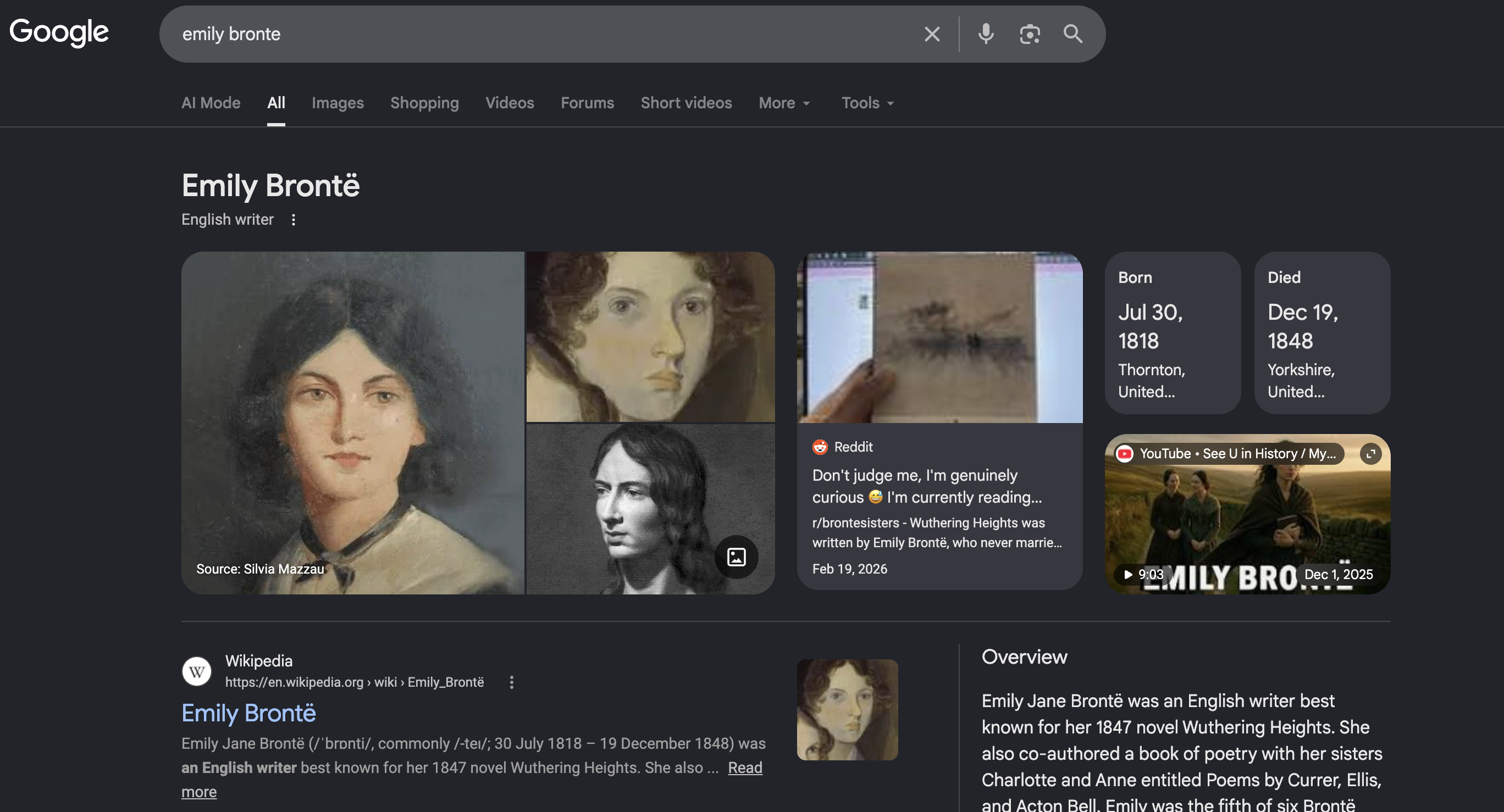
I have seen Emily Brontë’s face dozens of times, online, in books, and in my dreams. Where is the real Emily? Is there a definitive portrait? Why are there no photos? Can we trust any description?
My cursory searches in Google’s results pages immediately produced errors of attribution and provenance of claimed Emily Brontë likenesses. A simple “emily brontë” search misleads searchers by returning photos of likenesses that are not accepted to be real likenesses. This is just one of the contributing factors for this Emily Bronte website. If it’s so easy to get Emily wrong, who will put in the work to get it right?
The face everyone knows
The National Portrait Gallery holds two paintings by Branwell that include or are said to include Emily. The Pillar Portrait is catalogued as Anne, Emily, and Charlotte, painted around 1834. The separate profile is the surviving fragment of another family portrait, painted around 1833.1
The profile, while currently accepted as Emily, is still problematic. The Gallery’s extended catalogue entry preserves a long argument that the sitter may be Anne, complete with references to the Brontë Society articles in which the question was fought over.2
So the familiar portrait comes with a footnote large enough to stand beside it. Good. That gives me somewhere to begin.
What I am actually looking for
The Journal article is called “What Did Emily Brontë Look Like?”. It needs two registers.
The first will catalogue images: paintings made during Emily’s life, derivative prints, disputed sitters, later copies, colorizations, and the eventual army of imagined Emilys. The second will catalogue written descriptions along with surrounding details. Who saw her? When? When did they write it down? Where is that text now? Am I reading their words, a transcription, a biographer’s paraphrase, or a sentence that has spent a century improving itself?
The descriptions may be worse
The University of Leeds holds Ellen Nussey’s biographical note on Emily under the reference BC MS 19c Brontë/C14. Its public page prints a substantial passage about Emily’s reserve, expression, self-command, closeness with Anne, and affection for her dogs.3
The aim of the project is to catalogue and track down sources that are reliable and save it in one place for anyone to consume and use for their own research purposes.
What comes next
I need the complete catalogue histories for both Branwell paintings, the early tracings and reproductions, the articles arguing over the profile, and the original source behind each physical description repeated in modern biographies and websites. Joy.
Footnotes
-
National Portrait Gallery, Patrick Branwell Brontë, The Brontë Sisters, NPG 1725, and Emily Brontë, NPG 1724, checked 22 August 2026. ↩
-
National Portrait Gallery, extended catalogue entry for NPG 1724, checked 22 August 2026. ↩
-
University of Leeds Special Collections, “Ellen Nussey & Emily Brontë”, identifying BC MS 19c Brontë/C14, checked 22 August 2026. ↩